Monday, 26 January 2015

A Review: Half Girlfriend, by Chetan Bhagat

Chetan Bhagat once remarked that English is India's new caste system. He couldn't be more correct. This view point is aptly put across in his new book, Half Girlfriend .   Having been at the helm of a new wave of contemporary Indian writing, his books have been filled with gritty experiences supplemented with a very Bollywood-ish optimism, making them very easily readable by young Indian masses.  The plots are not complicated, the characters have something relatable, and there is an element of fundamental upbeat hope in his stories better than any Slumdog Millionaire. I had read some of his books before, some enjoyable, others uncomfortable, but this one will be the first reviewed formally. 

The story is that of Madhav Jha, descendant of the royal family of the Princely state of Dumraon , in Buxar, Bihar. Over generations, having lost their family wealth, the respect and honour of the title and the responsibilities it bore for the people of their region were what he and his mother were left with. A rather unsophisticated Bihari boy with little command over english, he secures a sports scholarship for basketball in St Stephens, one of posh Delhi's elite colleges. He meets the lovely, sophisticated english speaking Riya, from a wealthy business family through basketball, and is instantly smitten.

 But Riya isn't . She sees him as a friend, while he wants a serious relationship. His halting english, relative lack of sophistication, no obvious wealth, and perceptions, are but some of the hurdles that  have to be crossed.  As time and distance become a new barrier, Madhav tries to fight to sustain his love, while being a prince to his people back in Bihar. Will he succeed in winning her love? Will he be  the Prince his people need? 

The struggles in this book are very real, as are the characters. The not so subtle discrimination between the have and the have-nots, between the english speakers and those that struggle with the language, perceptions o community and background are very real, and have been captured well. The way these dynamics affect the way a relationship is viewed is also seen. The plot is decent, and the storytelling language simple, in keeping with the protagonist's headspace . The intensity of emotions has not really come through though. Bhagat's strength here is his clear character creation of the protagonist. 

We don't see the female lead as well developed , in contrast. Her actual development comes towards the end of her story, but even those parts are predictable and cliched, with little to give her solid outlines. We see what the characters go through, but we can't feel them as well. His male characters are clear, but his female characters are superficial. Bhagat would do well to try and cross the age old barrier of "understanding women", and actually write a character a woman reader would give her thumbs up to and want to empathise with. 

I should say, romantic , or upbeat endings seem to be Bhagat's forte. This book is something easily adaptable to a Bollywood script, and is along the "Swades" lines. It carries the optimistic vision of social change that is characteristic of today's metro educated urban under forty Indians who want a transplanted Singaporeistic vision of tomorrow. 

A fun read on the whole, and can be finished in a single sitting of a few hours. Best enjoyed in short breaks in the office, with a cup of chai, or on the commute home. 

Friday, 9 January 2015

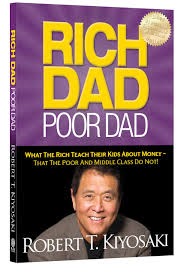
A Review: Rich Dad, Poor Dad, By Robert Kiyosaki

My father picked this book up in Bagdogra Airport,  telling me that he'd been recommended it, and it was a must read. He gave it to me to read on the flight and I'd finished with it by the time we landed. Rob Kiyosaki's advice got me thinking quite a bit. I am not a very financially savvy person, and given that my career is starting, it made sense to try and understand how to manage money. Having studied for four years in Gujarat, I was exposed to two sides; one, the face of the IIM graduates in the city, who spend two years and lots of money to study and earn an MBA, and go on to earning big bucks, and on the other hand practical,individual and  family run businesses, where the average education is high school, and the practicalities of running a business, gaining insight and acumen through experience, and being your own master was important. So this book , I hoped, might give me an insight here.

 Most of the self help books I've encountered , while containing important lessons, seemed like rewritten versions of each other, and seemed to focus on building the person and personality, whatever be the topic, with the winning smile characteristic of American salesmanship.

The book  , on the other hand, dealt with money. It deals with how both sides of the economic ladder
see money, what they do with it, and the kind of attitude moneymaking needs, tells us about the two father figures he had, a rich one, and a poor one, and the vast difference in the kind of advice he received from them, and his eventual choice of listening to his rich dad.

His book seems to challenge traditional middle class wisdom, of considering money to not be their cup of tea, of accumulating higher education, getting a job that paid you, and so on. The author says that every time we say things like, I can't afford it, we do not exercise our creativity, or the money making muscle. He emphasises , to begin, on the importance of gaining a practical financial education in the school going years itself, to help children and parents understand where their money goes, keep track of them, understand how the law works, and start consciously using the knowledge to make money grow. He states outright that his own interest is in making money, pure and simple.
He urges us to apply the same go-getter achiever attitude towards money matters as we would towards other important goals in life.

On the positive end, his book outlined and emphasised on things that could and should be implemented, such as diligent accounting, knowledge of the law, knowledge of finances, and how they would work, and so on.

On the downside, his book is a little putting off, in that , it is derisive of employees, the middle class, and those who steadily pursue higher education, stating that formal education has been framed to create employees, not employers. He suggests an attitude of doing away with them completely in favour of investing, business and entrepreneurship to say the least. Secondly, the strategies of personal experience in his book are written purely from the perspective of making money,rather than financial strategies implementable in various professional and personal contexts,  with money as the aim and the end goal.

To see it practically, most people worldwide focus on doing things, jobs and careers that bring them joy and happiness, and for whom,  intelligent money habits are similar to having a more balanced productive lifestyle, or rather, the result of the things they do in life. I doubt people set out "to make money" every morning. There have also been claims of the dubiousness of a lot of his stories. Not being an expert on financial matters in the Americas, I do not know how valid both sides of the claims are. Also, being in India, it becomes difficult to relate to the strategies in the book ,considering we would not have the same trade policies, the same tax laws, or similar financial conditions, It would take a fair amount of personal effort on the reader's end to be able to understand the financial framework India.

Have there been other books like this, maybe more Indian in context? I don't really  know, except recalling the odd non fiction book about the Ambanis, or a book about IIM's entrepreneurs, or the secrets of Gujarati trade practices.  But it would be nice to have a book that actually takes a good look at India's financial systems, and what financial strategies the average person can adopt to be financially secure and comfortable.

Would I recommend reading it? Yes, it is a decent book that kicks you out of procrastination and gets you to think about what you're doing with your money. But I would advise caution regarding strategies; this is an american book, for american audiences, with american financial conditions in mind. The Indian audience, the market, and even the financial guidelines will be different for us. This remains, to the effect , another motivational book for us. But do get down to doing your accounts! And pay attention to where your money is going!!!


Thursday, 4 December 2014

A Review: Harry Potter and the Chamber of Secrets , by J K Rowling.

This book is currently sitting battered next to me after my second reading wave. It was the first Harry Potter book my father bought for me, and the doodles and stickers I find inside bring back memories of how I used to have reading marathons at home as a kid. Rereading the second book was quite refreshing, and as I mentioned in my previous review, it allowed me to look at the series with fresh eyes.

This book opens with an argument at breakfast between Harry and the Dursleys, about Hedwig, Harry's owl, being locked up.The Dursleys have locked up Harry's things and his owl, to prevent him from communicating with his friends and using magic. The Dursleys make plans to invite a builder and his wife for dinner, to seal a deal with Uncle Vernon's firm, and Harry's role is to remain quiet, unseen and unheard, presumed non-existent. Plans go awry when Harry finds a house elf, Dobby,in his room, who tries to persuade Harry not to return to Hogwarts, due to great 'evil' coming up in Hogwarts. Dobby's determination extends to brutal sabotage, where he performs magic in front of the guests, smashing a pudding , to ruin the dinner and lock Harry up.

Harry is rescued from his imprisonment by Ron and his brothers, the twins Fred and George in their father's flying Ford Anglia, escaping the Dursleys and landing at the Weasley's residence, the Burrow. They spend the summer there, and on the day they're to return to Hogwarts, they have trouble getting onto the platform, miss the train, and decide to fly the car to Hogwarts. They end up crashing into a tree, and are severely admonished for their rather dramatic entrance. Incidentally, they have a new professor for Defence against the Dark Arts a rather questionable, narcissistic celebrity, Professor Lockhart, who has a penchant for dragging a reluctant Harry into unnecessary spotlight. This year also marked Ginny's entry into Hogwarts, Ron's painfully shy and insecure sister .

Beginning with the caretaker's cat, when a series of Muggle born students are attacked and left in a state of frozen petrification, with threatening messages alleging the presence of a Chamber of  Secrets that means to purge the school of unworthies , a duelling club is organised for the students , where an encounter with a snake causes Harry and the rest of the school to discover his ability to communicate with snakes.Since this language, Parseltongue has been known to be used by Salazar Slytherin and dark wizards of his line, Harry is now the prime suspect behind these attacks.

Harry, Ron and Hermione try to find answers by working in a haunted girls' toilet , conjuring forbidden potions, where Harry comes across a mysterious blank diary that responds to what the owner writes, belonging to a Tom Riddle. When Hermione herself is attacked, they work faster to uncover a series of connections with Hermione's own clues, and eventually discover the Chamber of  Secrets, the person who opened it, the monster within , the real culprit and how it all revolved around Harry. A battle in the Chamber ensues, destroying both the monster and the vestiges of the culprit. They eventually manage to leave the Chamber, and clear the situation with Professor Dumbledore. Harry manages to free Dobby too, and the year ends on a high note again.

This book sees the characters grow up a little, but not much; they still have a healthy disrespect for school rules. The tone of the story is rather more serious, and the sense of wonder we see in the first book is now replaced with familiarity and curiosity, while navigating possibilities in a magical landscape. Witnessing Harry's abuse far more directly and vividly right from the beginning, the series ceases to be the fairytale it was in the first book. The topics of fame, insecurities, reputation, ability, truth, and loyalties start coming in. Gilderoy Lockhart craves attention and reputation and is willing to go as far as possible to further it, Harry struggles with his own reputation and tries to stay both away from attention and clear his reputation, Tom Riddle is trusted while Hagrid is punished, all on account of their reputations.  We also see a second social issue, that of social divide, possibly a reflection of racism and slavery, concerning the discrimination between so called Pure Bloods and Muggle born students, and wizards and other magical creatures.The conflict between these, and the struggle to resolve them, marks a turn towards tolerance and narrative seriousness. The book grows up a little, as does the reader's range.

I do have a point of debate with Rowling's narratives, in that, her stories gain momentum and the plot moves on, not as much with the deductions and adventures of the protagonists, which readers should ideally be able to do in parallel, but by introducing new bits of information present at each stage, culminating in shocking finales.The plot advances with the information presented. While one may argue that the wealth of magical knowledge in that universe is too vast for readers to be presented a concise picture to reason with, the fact that in each case, action could be taken by a trio of teenagers, in this case, twelve year olds, while adults save for Dumbledore, who did have access to greater information and awareness, could not connect dots, one can assume plotwise in the series that maybe they could have been streamlined to advance more on the basis of the characters themselves, and not newer information?

Perhaps, a factor for the series' success is the sheer bulk of information itself, their complexity, and requiring considerable of imagination in every scene, something maybe other fantasy authors would not have bothered with after establishing the scenario. In this case, the experience is like discovering gold nuggets in every sieving of sand, connections and parallels can be drawn at every point, with every re-read bringing up new insights.

The second book presents several important themes in a rather prophetic manner, something a reader would only realize after having read the series. If the first book established Harry's magical identity and his first adventure, the second book effectively introduced themes and positioned Harry opposite his nemesis, and set the tone for future books to follow. 

Monday, 24 November 2014

A Review: Harry Potter and the Philosopher’s stone, by J K Rowling

The Harry Potter series in recent decades has been a literary phenomenon and a landmark in fantasy writing over the ages.  My first Harry Potter was the second one, Chamber of Secrets, but as predicted, I could not make sense of what had then I read since I hadn’t read the first. A colleague of my mother was a Harry Potter buff, and lent me the first one. Like every other excited teenager, I too was hooked, got my books early, devoured them like religion and obsessed over the stories and characters. I grew up with the books, and read them over and over, often in competition with my cousins.  I also eagerly awaited the movies that came out, and slowly, my heart shattered. The Harry Potter  I had envisioned , and the way some of those stories were told had done little justice to reading the master pieces themselves, and, sadly, over time, I stopped obsessing over them as much as I used to. In fact, my reading methods changed. I no longer was as absorbed in the books I read, and ceased to retain a perfect memory of what I read.

I continued to read though, a tad impatiently, until a fellow bookworm friend asked me to revisit the books I used to read when younger, and maybe notice if I read them with different eyes.

I took up on that suggestion, and Harry Potter was the first series I challenged.  They had been a big part of me growing up. So re-reading it after a long time was also a nostalgia trip. I may receive brickbats from other Potter aficionados for my perspective on things, but in my defence, hey, after five years of separation, I am trying to get my religion back here!

In the first book, Harry Potter and the Philosopher’s Stone, we are introduced to the Dursleys, a seemingly picture perfect respectable upper middle class thatcherite family with a skeleton in their closet; their cousins, the Potters, a family as out of the ordinary as can be. Ominous occurrences, such as owls in daytime, people in cloaks, and shooting stars are a prelude to the surprising arrival of baby Harry Potter on the Dursleys’ doorstep. Harry, the tiny skeletal boy, the skeleton in the Dursley closet, grows up in a closet as the family’s punch bag, until the days leading up to his eleventh birthday, where the extraordinary pursues Harry and plagues the Dursleys to the point of denial. Answers arrive in the shape of Hargid, a huge friendly giant with a letter of acceptance into Hogwarts School of Witchcraft and Wizardry. Hagrid also reveals to him his true identity and calling, not only as a wizard, but as The Boy Who Lived, the only survivor of a fatal encounter as a baby, with Voldemort, a murderous malignant tumour on the magical landscape, a notorious, seemingly unsurpassable practitioner of dark magic, which has made him famous throughout the magical world.
Harry is fascinated by the magical world he belongs to and dealing with his new found identity (but not fame).

He enters Hogwarts, gets sorted into his house, Gryffindor (for the brave only), makes new best friends, Ron( his bro) and Hermione (the sensible ), encounters and learns things strange, interesting and fascinating, discovers a prodigal passion for Quidditch, runs into a pile of mischief like a good eleven year old, (one does wonder, if given the excessive punishment he received at the Dursleys’ , Harry has become rather subconsciously thick skinned, and knows he would be treated far better at Hogwarts, prompting his proactive risk taking?) and becomes the target of a professor,Severus Snape’s dislike. This dislike, taken along by a series of events whose dots he and his two friends manage to connect, uncovers a conspiracy to steal the famed Philosopher’s Stone. 

Given the dismissive response they receive from the professors, they take it upon themselves to save the stone, embarking in an overnight adventure that tests their mettle. And the surprise that meets Harry in the final stage, an unexpected face off with an enemy one could not imagine, and a memorable battle to save the stone, the day, and by extension, the world.

Harry wakes up in the hospital wing, well rested and recovering, to a pile of sweets and an indulgent headmaster, Professor Dumbledore, who has the answers and concludes their adventure.  Harry, Ron and Hermione reunite for a memorable term end feast, where, as the high point, their crazy adventure wins points for their house, Gryffindor, and wins them the House Cup.

The book ends on a note of euphoria, as the academic term ends, and the students have to head back home. Hagrid(is he Rowling’s take on Roald Dahl’s Big Friendly Giant and Santa?) presents him one of his treasures, an album with pictures of his late parents. The story ends on a happy, hopeful note, with promise of something exciting to come.

Certainly the book has its light parts, but it also broaches things that most children that age start to think about. The non-obsessive detachment that Harry has, in spite of his issue-filled backdrop, and by simply being a normal eleven year old kid, and even viewing himself in that light, allows us to connect with him. His excitement at the magical world opening up in front of him, and the many sides, good, bad and ugly, washing over him, allows the audience to bathe in that sensation too. The way he has been written into this book, is that certain aspects of his life are revealed, and enough breathing space has been given in the character’s headspace, for readers to imagine his experiences, and draw up their own version of him. Harry may have begun as an Oliver Twist type deprived orphan, but he embraces his destiny, tries to rise to the challenge as much as an eleven year old in a magical new world can. This becomes a  symbol and a role model for his readers. This would probably explain how emotionally difficult it was for a lot of Harry Potter lovers to reconcile with the on-screen portrayal of the character, and the narration of the story. I suppose seeing Harry and his world tangibly contribute to the gap between the books and the films.

Harry Potter and the Philosopher’s Stone is a fairy tale. It is a fairy tale, written with the whimsical quality needed to capture an eleven year old reader. The best thing about Rowling’s writing is that she does not underestimate the children who would read her book, and has therefore, imparted a certain strong writing quality to the book. 


As an adult, the feeling the book left me with, was a happy one; a book with a child protagonist I would love, the right dose of whimsical, magical and adventurous, a motley bunch of complete characters, and a treat to the imagination, and to good literature. A yummy book indeed! 

Saturday, 22 November 2014

Writing online

Lately, it seems I haven't been doing too much writing, which is not good. I have restarted reading, and discovered the online writing forum, Wattpad. I've been reading a lot of stuff that has been put up, which is sadly, the usual "OMG that is ssoooooo haaaawwwwwwt! (drrroooooolllll) " type. What I admired about these people is that they love writing , and have put in some effort into narrating stories. But last night, when I encountered the nth story with the same storyline, I'd really had enough.

SO that brings me to my new mission. To write something a little sensible , and put it up on a regular basis, since I felt I had no right to criticize people who write, when I don't do much writing myself.
This blog itself has been an effort like that, for me to get back into writing .

As being the situation with most writers being voracious readers, I want to review the books I read on a regular basis to begin with, and turn that into a series for my blog, and tackle my tendency to procrastinate , killing two birds with one stone. Most of the books I review would be published ones, and if by chance I encounter some good writing and storytelling on Wattpad, I will review that too.


A Review: Ice Station Zebra by Alistair Maclean

My father , a thorough bookworm, has a sort of bias at home regarding buying books. He would rather spend money buying books that would last, be re-read, or referred to, or classics that are otherwise unavailable, and the others, were to be picked up at a library, or borrowed, due to their being one-time reads. In retrospect, the sight of our overflowing bookshelves leads me to believe he had a point.

The return home after submitting my thesis put me in a holiday mood, and I ended up rummaging inside the overflowing bookshelves at home, trying to find a read that would be fast enough, and engaging enough to take me through a lazy day. I came across a copy of the Alistair MacLean novel, Ice Station Zebra, which I had read once before, and remembering the good feeling I had that last time I read it, decided on it this time too. I wondered whether I would read the same book very differently a few years later, from the time I read it first, and to test this theory, picked it up again.

My first encounter with Alistair MacLean was through cinema, not books, specifically the Carl Foreman movie, The Guns of Navarone (which made me a huge fan of Gregory Peck, and World War II stories). I had picked up Ice Station Zebra in an airport, and it did not disappoint. It had the Alistair MacLean signature pace, and was a great read.

On a Scottish coast, in the Cold War era, we encounter the United States submarine, the Dolphin, a state-of-the-art submarine, that is ready to leave shore in the morning, heading to the Arctic circle when the crew are greeted with a surprise new addition, a Dr Carpenter, who insists on joining them , and with authority over the crew, citing orders from NATO, via telegram.The mission that the Dolphin has been deployed on, is to rescue the stranded British researchers on a meteorological station , the Drift Ice Station Zebra, on a drifting chunk of ice in the Arctic Circle, following a terrible fire accident there, that leaves few survivors, and little hope of survival, given the harsh conditions towards the North Pole. Dr Carpenter's presence and his insistence to join the crew turns a typical rescue mission into a matter of political urgency.

Dr Carpenter professes to being a doctor with specific training related to submarine and arctic conditions, and manages to convince the Captain, Swanson, and the crew to accept him on board, after confiding in the Captain that the Drift Ice station was in fact a top secret location for monitoring Soviet missiles, whose activities need to be protected. That the head of the Drift Ice Station Zebra, Major Halliwell, is Dr Carpenter's brother, is also revealed early on.  While the voyage is underway, we are introduced to the nuclear submarine's layout and features by the submarine's doctor, Benson. The submarine manages to pick up weak interrupted signals from the station, and dives below the Arctic Ice , in order to get closer, searching for a location with thin enough ice to break through and reach the station.

Carpenter, and two other crew members alight a few miles near the station, and braving a blizzard, reach  the station, where they are greeted with a scene of devastation.  A series of prefab huts built to house the residents and the equipment have caught fire,and the one remaining intact hut houses the seven starving, frostbitten and wounded survivors. Carpenter's brother unfortunately, was one of the eleven who perished, their bodies charred . While looking around, Carpenter finds evidence of foul play, and believes the fire to be caused due to arson and not by accident. They return to the Dolphin, which tries to get closer to the station by diving under the ice, and torpedoing its way closer, but sabotage in the torpedo area puts the submarine at risk, which is brought under control with great difficulty. The few members of the crew having Carpenter's confidence are on alert for foul play, following the alert, and they arrive at the station and pick up the survivors. The station is scrutinised again covertly, while providing relief and picking up the survivors.

After getting the survivors on board, the Dolphin and its crew are beset with a series of accidents, from engine malfunction, to physical harm. The sequence of these events and the culprits of the massacre at Ice Station Zebra are unmasked, following the revelation of Dr Carpenter being a member of MI6, the British Intelligence wing, and the eventual clever frustration of the culprits' plans (and eventually saving the skins of the US- UK bloc).

The book is a racy , fast paced read, with all the urgency of a military novel. Alistair MacLean writes crisply, and beautifully. As with all whodunits, there are a series of small clues and pick up points scattered through out the book, which the reader has to pay close attention to in order to connect things well. I ended up having to go back and forth, trying to make the cross connections. I felt that the pace of the book did not run hand in hand with the amount of information presented and digested in the plot. Many points in the book's narrative refer to the layout of the Dolphin, and also the layout of the station, which are helpfully provided diagrammatically in the first few pages, but the narrative causes us to flip pages repeatedly to recognise what the author refers to.

The book lasted a day, and left me feeling refreshed. The book caused me to think well, and kept me hanging off the suspense cliff reasonably often, and the narrative was engaging. The book is written to be read in one sitting if we are to make sense of its complexity, and in this sense,it is in the same league as Dan Brown's and John Grisham's thrillers, a book that, in spite of the dated context and story, reads like a contemporary thriller.

Considering books with wartime themes, Alistair MacLean is one of the few authors who understands and brings about the wartime scenario very well in his books. Perhaps it has to do with the fact that he has lived through the second World War. A contrast in the style, or even in the simple portrayal of tumultuous war-like times, are two books, Anne Frank's Diary of a Young Girl, and the last Harry Potter book, Harry Potter and the Deathly Hallows. All three speak of a War-like situation. Dr Carpenter is a man incognito on a mission, so are Harry and his friends. Anne and her family are in hiding trying to survive the war, as are Harry's supporters .

In Ice Station Zebra, we encounter the writing of an author who has been in the thick of action, in actual battles and therefore writes from experience. The crisp effectiveness of communication, the filtering of emotional drama, the need for the right action at the right time, and the urgency and weight of these actions are well brought out in his books. From Anne Frank, we learn of the oppressive daily life led by those in hiding, and the edge they have to live on. J K Rowling tries to draw both themes close in her last book, but the impression of the reading experience, or the scenario presentation is nowhere near as intense as Alistair MacLean's, or Anne Frank's , and ultimately,one has to fall back on Rowling's own imagination. But the reviews of both Harry Potter, and Anne Frank, will be dealt with later.

All in all, a wonderful whodunit, from a master of wartime intrigue. Who can say that racy thrillers are written only in today's time?


Tuesday, 2 September 2014

A Review: Manuscript found in Accra, by Paulo Coelho

Like maybe many of his readers, I have a tendency of associating Paulo Coelho with a highly philosophical bent of mind. So it came as no surprise when one of his recently released books, 'Manuscript found in Accra' once again approached life and philosophy, in alignment with his world view, that we see time and again in his previous books, starting with his prominent bestseller, The Alchemist.

 The book opens with a narrative account of the discovery of papyrus manuscripts in Hamra Dom, Upper Egypt, which are taken to the Cairo Museum. These manuscripts, now called the Manuscripts of Nag Hammadi , contained writings known as the Apocryphal Gospels, essentially, Gospels documenting the life of Jesus Christ that were rejected during a bishops' meeting for the compilation of the Bible in AD 170, since the Gospels were either written by women, or held views or portrayed the Christ in a manner deemed not coherent with the perception of the Christ that they wished to propagate.

Post this, a different manuscript, dated as recent as the 1300s, was found in Accra by a certain English archaeologist, Sir Walter Wilkinson. This manuscript had about 155 copies floating around, and they were all dated to the same period, and considered identical.The manuscript's copy was lent to Paulo Coelho , who transcribed it into the book presented to us.

It begins with a simple wish, stating that considering the narrator's time is over, whatever he has learnt has been bequeathed to us, the future generations with the hope that we make good use of it.

The narration is set Jerusalem, just before a Crusade invasion, variously dated the year 1099 by the Christian Calendar, 492 by the Islamic estimate, and 4859 by the Jewish calendar, where the occupants of the city of Jerusalem are gathered. The occupants are a mixture from all three faiths, and the soldiers of the city choose to guard it from the invading French Crusaders from their respective posts. All the residents are gathered in the same square where the Roman Governor Pontius handed Jesus over to the mob for crucifixion, and mentally prepared for a fight to the death , a slaughter awaiting them the coming morning at the hands of the French. It is ironic, that with the Crusades' efforts to reclaim Jerusalem as a Christian spot, we see people of all three Abrahamic faiths defending it equally.

They are gathered to hear the words of a Greek man who calls himself the Copt, in the presence of representatives of each faith, as last words before the slaughter at sunrise.
The Copt is an outsider, who does not practise either of the three faiths, but believes in the present moment, in a Divine Energy called Moira, and its one single law, which, when broken, would shatter everything. However, his own beliefs do not come through in the book, which focuses on common wisdom.

The Copt proposes a question and answer session with the public,setting the impending battle aside, as a means of sharing knowledge and wisdom as done by philosophers in Ancient Greece. He suggests leaving behind a legacy of wisdom for coming generations.

The first question is regarding defeat. The Copt says only he who gives up is defeated, and proceeds to outline what being defeated actually is. With the second question, he distinguishes Defeat from Failure, in the face of trial and doubt. The next question addresses Solitude, followed by the concept of self depreciation. He further goes on to address various topics such as being receptive to change, taking decisions, beauty and elegance, sex, unity, the passage of time and life, duty and happiness, luck, miracles and angels, anxiety, the future, loyalty, and many more.

The narrative arms its listeners with the one last song of wisdom they need to carry in the face of death.

It is an uplifting narrative. In certain parts we come across phrases, expressions and points of view that also appear in other books by Coelho. With most of his books carrying references to tenets in the Abrahamic faiths, one wonders if the common phrases he uses are his own, or out of the texts from these faiths. For those who do not follow either of the faiths, and are thus unacquainted with aspects of these faiths, we read them in good faith of their being the author's creation.

The tone of the translation carries the pensive pondering mood of a day in Middle East and Africa. In spite of being spoken in the face of impending death, the words carry none of the urgency ,resignation and hopelessness that is typically associated before certain annihilation. The words of the wise man are recorded, bu the moods and doubts of the listeners do not come through. For a fairly large population , the question answer session is recorded as a surprisingly civil patient affair.

This is yet another book by Paulo Coelho, where we see faith, wisdom, knowledge and courage becoming common denominators of an all embracing philosophy that he seems to subscribe to, regardless of culture and community and as always, tries to answer to the human condition.

All in all, a good read, that can be read in a single sitting. Paulo's writing is smooth, and easy on the reader, and the book can be read without caring for the sequence of chapters as well. A decent spot in modern philosophy and world view, and perhaps a voice of tolerance and calm, or rather, wisdom and understanding in a world increasingly rocked by religious hatred and reaction.